
Quick Answer: How Sun Exposure Affects an Athlete’s Skin
Sun exposure for cricketers, footballers, and other outdoor athletes builds up in ways that go way beyond a bit of redness after training. Hours under open sky mean cumulative UV damage to skin cells. Sunburn shows up now; premature wrinkling, dark spots, and a higher skin cancer risk show up later, quietly, over years. Sweat breaks down sunscreen faster than you’d think. And reflective surfaces — turf, dry pitches, even puddled water on a rainy match day — bounce extra UV straight back at you. The fix comes down to three things: broad-spectrum sunscreen applied properly, protective clothing and shade whenever you can grab it, and a bit of smart scheduling around the sun’s worst hours.
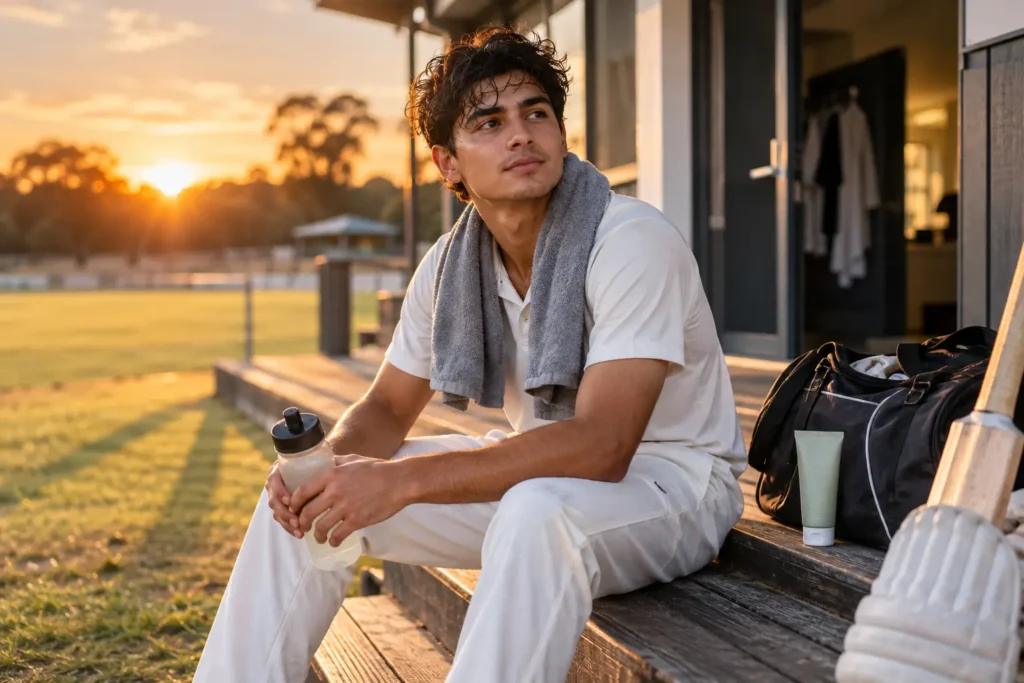
Why Cricketers, Footballers & Outdoor Athletes Are at High Risk
Not all outdoor sports expose you to the sun the same way — that’s the part people miss. Cricket matches often stretch across a full day, with fielders and umpires stuck out in open grounds for hours with barely any shade. Football matches run a fraction of that time, but players still take concentrated, high-intensity bursts of sun, often on pitches with next to no shelter at the boundary. Runners and cyclists land somewhere in between: shorter sessions than a day of cricket, sure, but moving air and heavier sweating make it easy to underestimate just how much sun you’ve soaked up.
The common thread is the UV index — the scale that tells you how strong the sun’s ultraviolet radiation is on a given day. Higher number, faster damage. UV levels generally peak around midday, though the exact timing shifts with latitude, season, and altitude. A cricketer fielding through an afternoon session, a footballer training at noon, a cyclist on a long midday ride — all three are gambling with peak-hour sun, whether they’ve clocked it or not.
Sport-Specific Exposure Patterns & Position-Specific Risks
Not everyone on the field carries equal risk. Your position and your schedule both matter here. Match days are usually worse than training simply because games run longer and you can’t step off just because you fancy a breather. Artificial turf throws in another wrinkle too — synthetic surfaces reflect a surprising amount of UV back upward, so even the “shaded” side of your face can catch rays you never planned for. Indoor stadiums sidestep the whole problem for footballers, obviously, but plenty of clubs still train and play outdoors for most of the season.
Within a squad, some roles just cop more sun than others:
- Deep fielders in cricket, stuck in the same spot for an entire session with zero shade.
- Bowlers, who repeat their spell over and over in direct sun, often on the sunniest side of the pitch.
- Umpires — no rotating off, no bench, full day in the open.
- Goalkeepers, rooted to one exposed patch of turf for the whole match.
- Wingers and full-backs, covering the flanks, usually the least shaded strip of a football pitch.
If you’re in one of these roles, sun protection isn’t an extra — it’s part of your kit.
Sunscreen: SPF Choice, Application & Mid-Match Reapplication Routine
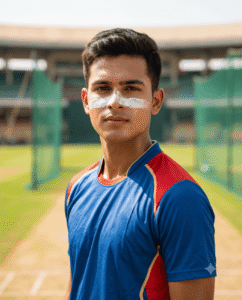 What sunscreen should cricketers and footballers use? Go broad-spectrum, water- and sweat-resistant, SPF 50+, and put it on 20 to 30 minutes before you step onto the field so it actually has time to bind. Broad-spectrum matters because it blocks UVA and UVB — skip one and you’ve left a gap in your defense.
How often should sports players reapply sunscreen during a match? Every couple of hours where the game allows it — drinks breaks, innings changes, half-time, any timeout — and always right after a heavy sweat or a dunk in water. A routine that actually works looks something like this:
- Apply generously to all exposed skin 20-30 minutes before warm-up.
- Top up at the first natural break — drinks interval, quarter-time, whatever your sport gives you.
- Reapply again at half-time or the innings break.
- One more round if the match drags on or things get sweatier than expected.
Keep a zinc oxide stick in your kit bag for the nose, ears, and lips — thicker-skinned spots that regular lotion tends to skip over. Spray and stick formats are worth the extra money here; they let you reapply in seconds without breaking rhythm or getting cream in your eyes.
Protective Clothing, Hats & Sunglasses
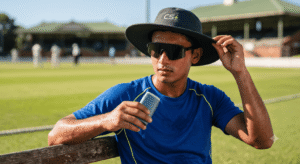
Clothing is honestly your easiest win — cheaper than most people think, and you barely have to remember to do anything once it’s on. UPF-rated jerseys and base layers are widely available now, and they cut down significantly on the UV reaching your skin compared to a standard cotton or polyester shirt, something dermatology and textile testing bodies have been documenting for years. Fielders and umpires do well with wide-brim or legionnaire-style hats that shade the neck and ears, not just the face. Footballers can’t exactly wear a brimmed hat mid-game, but a cap during warm-ups and a turned-up collar (where the kit rules allow it) still help. Polarized, UV-blocking sunglasses finish the job — less glare, and some protection for the thin skin around your eyes. A few sportswear brands now weave UV-protective fabric straight into training kits, so it’s worth checking your gear list rather than assuming your usual jersey has you covered.
Shade, Timing & UV Index Awareness
Where you have the choice, shift training out of the harshest midday window. Early morning or early evening sessions cut your exposure without touching your workload at all. Match days rarely give you that luxury, so use every scrap of shade going — dugouts, boundary rope shelters, even just standing behind a teammate during a break. Check a UV index app before you head out. It takes ten seconds and tells you whether today’s a “usual routine” day or an “apply extra, reapply sooner” day. Beats guessing.
Post-Match Skin Recovery, Hydration, Nutrition & Aftercare
 Does sweating make sunburn worse for outdoor athletes? Yes. Sweat strips sunscreen off faster than you’d expect, and once skin’s already sun-stressed, salty sweat sitting on it just adds insult to injury. Which is exactly why reapplying during breaks matters as much as it does.
After the final whistle or the last wicket, a cool shower calms heated skin and slows further irritation. Follow up with aloe vera or a gentle, fragrance-free moisturizer if you’re seeing any redness, and a cold compress helps on spots that feel especially hot or tight. Rehydrating properly supports your skin’s natural barrier repair — dehydrated skin just recovers slower from sun stress. Nutrition plays a quieter role too: antioxidants like vitamin C and E (fruit, vegetables, nuts) and omega-3s from fish or supplements support skin resilience over a long season of repeated exposure. And yes, some sun helps your body make vitamin D — but that’s not license to skip sunscreen. You’ll get plenty of incidental exposure during any full training session or match, trust me.
Mental Barriers: Why Athletes Skip Sun Protection (and How to Fix It)
Most athletes skip sunscreen for practical reasons, not because they don’t know better — greasy grip, sweat stinging the eyes, or just that locker-room feeling that sun cream isn’t “tough.” Fair concerns, all of them, but easily solved. Lightweight gel or spray formulas absorb fast and won’t mess with your grip on a bat or ball. Team sunscreen stations near the changing room turn it into a normal pre-match habit instead of a personal chore nobody bothers with. And coaches setting the tone — applying it themselves, mentioning it at the toss or the warm-up huddle — shift culture faster than any poster on a wall ever will.
Long-Term Skin Cancer Risk, Self Skin-Checks & Youth Athlete Guidance
Can playing in the sun cause skin cancer? Repeated, unprotected UV exposure over years is a well-established risk factor for melanoma and for basal and squamous cell carcinoma — the two most common forms of skin cancer. Outdoor athletes who train and compete for decades without consistent protection are racking up exactly the kind of exposure that raises this risk.
Run a simple ABCDE check on your skin every few months, especially on your face, forearms, and neck:
- Asymmetry — one half of a mole looks different from the other.
- Border — edges are ragged, blurred, or irregular instead of smooth.
- Color — uneven shading, or more than one color in a single spot.
- Diameter — noticeably bigger than a pencil eraser, roughly 6mm or more.
- Evolution — any mole changing size, shape, or color over time.
Spot any of that, get it checked by a dermatologist. Don’t wait it out.
Junior athletes need this even more, since childhood and teenage sun exposure feeds heavily into lifetime skin cancer risk. Schools and grassroots clubs should build sunscreen breaks and shaded rest areas into training schedules as standard, not as some optional extra tacked on when someone remembers. Parents and coaches carry real weight here — the sun habits kids pick up on the junior pitch tend to stick for life.
FAQ: Your Sun Safety Questions Answered
How does playing outdoor sports affect your skin?
Extended time under UV rays causes sunburn short-term and speeds up skin aging and skin cancer risk over years of cumulative exposure — sweat and reflective surfaces like turf make it worse.
What sunscreen should cricketers and footballers use?
A broad-spectrum, sweat- and water-resistant SPF 50+ sunscreen, backed up with a zinc oxide stick for the nose, ears, and lips.
Can playing in the sun cause skin cancer?
Yes — cumulative, unprotected UV exposure over a playing career is a recognized risk factor for melanoma and for basal and squamous cell carcinoma.
How can athletes protect their skin from sun damage?
Combine sunscreen reapplied through the day, UPF-rated clothing and hats, sunglasses, and shade during breaks, and time training outside peak UV hours when your schedule allows it.
Does sweating make sunburn worse?
It can — sweat washes sunscreen off faster and adds irritation to skin that’s already sun-stressed, so reapply as soon as you get a break.
How often should sports players reapply sunscreen during a match?
Roughly every couple of hours, at any natural break in play — drinks intervals, half-time, innings changes — and always right after heavy sweating.